100 Bedtime Story Prompts (Sortable by Emotion)
By Soothly Editorial · 8 min read
Last reviewed June 12, 2026
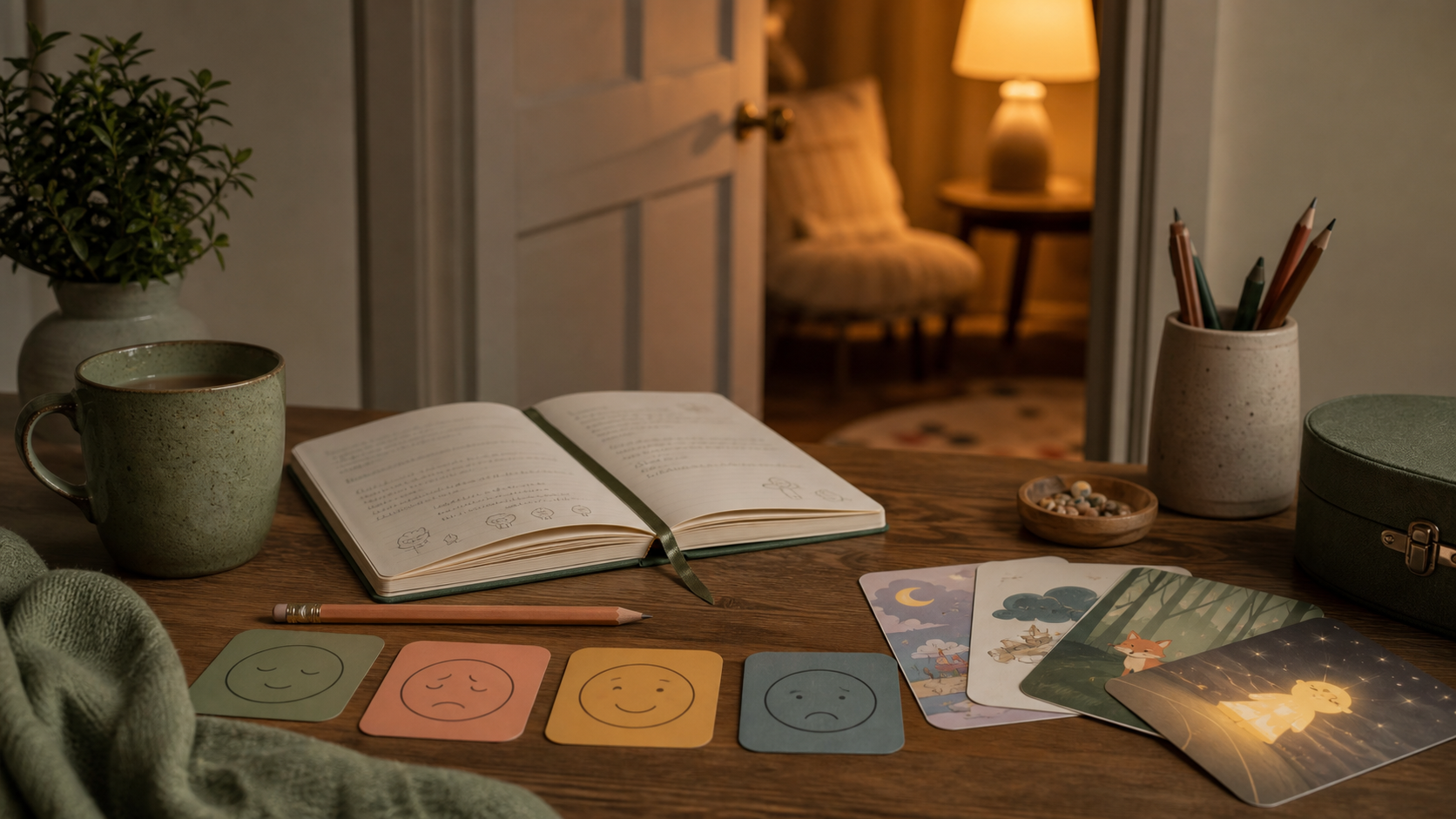
Bedtime story prompts work best when they are not random.
The right prompt gives a tired parent a small doorway into the exact feeling a child is carrying tonight: worry, anger, sadness, separation, jealousy, excitement, or plain old bedtime resistance.
This list is built for real evenings. You can scan by emotion, choose one image, and turn it into a three-minute story with a soft landing.
How to use a bedtime story prompt
Start with three pieces:
- A small character: an owl, fox, pebble, moon, boat, blanket, robot, or cloud
- One feeling: worried, angry, lonely, brave, jealous, disappointed, overstimulated
- One safe ending: the body settles, help arrives, the character repairs, or morning feels possible
You do not need a clever plot. A child at bedtime usually needs recognition and rhythm more than surprise.
Try this shape:
- The character has the same feeling as your child.
- The feeling gets pictured as an object, weather, sound, or creature.
- A calm helper arrives.
- The character tries one small coping step.
- The story ends in safety.
Prompts by emotion
- Worry: A small owl packs tomorrow into a tiny suitcase, then learns the suitcase can wait by the door.
- Anger: A dragon discovers that smoke can become a warm signal instead of a fire.
- Sadness: A moon snail carries a little rain cloud until a friend brings a lantern.
- Separation: A pocket star travels between two homes and glows when love is far away.
- Bravery: A shy rabbit takes one pebble-step across a bridge made of kind words.
- Jealousy: A fox cub finds out that love can grow a second chair without moving the first one.
- Change: A caterpillar decorates a moving box with pictures of what stays the same.
- Sleep: A tired bear learns that every yawn is a boat rowing toward morning.
Prompts for anxious nights
- A little boat worries the moon will forget the way home.
- A squirrel counts every acorn twice before bed.
- A cloud thinks tomorrow is too big to fit through the window.
- A lighthouse learns it can shine without checking the whole ocean.
- A tiny train feels nervous about the first station in the morning.
For anxious children, keep the story slow. Do not make the danger too vivid. Let the character notice the worry, ask for help, and practice one repeatable line:
"I can do the next small thing."
Prompts for angry nights
- A dragon's sparks keep jumping out before his words do.
- A volcano learns to rumble before it erupts.
- A red kite pulls hard against the string, then learns the string is not a trap.
- A bear cub stomps so loudly that the forest starts listening.
- A thundercloud finds a soft hill where it can rain safely.
For anger stories, avoid shame. The lesson is not "do not be angry." The lesson is "anger is a signal, and repair is possible."
Prompts for sad nights
- A little shell misses the sea and learns to hear it in a cup.
- A blue mitten loses its pair, then finds a warm pocket.
- A rainy window keeps watch until the first star appears.
- A moon snail carries one tear to a garden that knows what to do with it.
- A small bench waits for someone who is not coming today.
Sadness stories should not rush to cheerfulness. Let the sadness be held. A quiet ending is enough.
Prompts for separation
- A pocket star glows in two places at once.
- A paper boat carries a goodnight message across the hallway.
- A teddy keeps one hug in each paw.
- A little fox learns that goodbye has a return path.
- A moonbeam visits every bedroom in the same family.
For separation stories, repeat connection language: "Love can stretch. Love can wait. Love comes back."
Prompts for overstimulated nights
- A carnival mouse turns off one tiny light at a time.
- A noisy robot discovers a quiet button behind its heart.
- A sparkle jar learns to let the glitter fall.
- A marching band becomes a lullaby.
- A busy bee folds each buzz into a flower.
The story should slow as it goes. Shorter sentences near the end help your voice become part of the wind-down.
A simple prompt formula
Use this when you are too tired to invent:
"Once there was a [small character] who felt [feeling]. The feeling looked like [image]. Then [helper] showed them one small way to feel safe. By the end, [safe ending]."
Example:
"Once there was a little owl who felt worried. The worry looked like a suitcase packed with tomorrow. Then the Moon showed Owl a shelf beside the bed. Owl put the suitcase there and whispered, 'Tomorrow can wait until morning.'"
That is enough. Really.
When prompts are not enough
If bedtime anxiety, sadness, anger, or sleep disruption is frequent or intense, prompts can support your routine but should not be the only support. Patterns that affect school, sleep, eating, separation, safety, or family life deserve a conversation with your pediatrician or a child mental-health professional.
Create a story from tonight's feeling
Choose one feeling, one character, and one safe ending. Then let the story do less than you think it needs to.
Create a calming bedtime story for tonight
Sources
- American Academy of Pediatrics / HealthyChildren: Healthy sleep habits
- CDC: Child Development
- Reading Rockets: Reading aloud
Frequently asked questions
What makes a good bedtime story prompt?
A good prompt has a small character, one clear feeling, and a safe ending.
Should bedtime stories teach a lesson?
They can, but the lesson should be gentle and indirect rather than a lecture.
How long should a prompted bedtime story be?
Three to five minutes is often enough for tired children.
Can prompts help anxious children?
Yes, if the story names worry gently and ends with safety rather than dramatic danger.
What if I am too tired to invent?
Use a simple formula: character, feeling, helper, one coping step, safe ending.