CBT-inspired techniques parents can use at home
By Tim Khuja · 8 min read
Last reviewed June 9, 2026
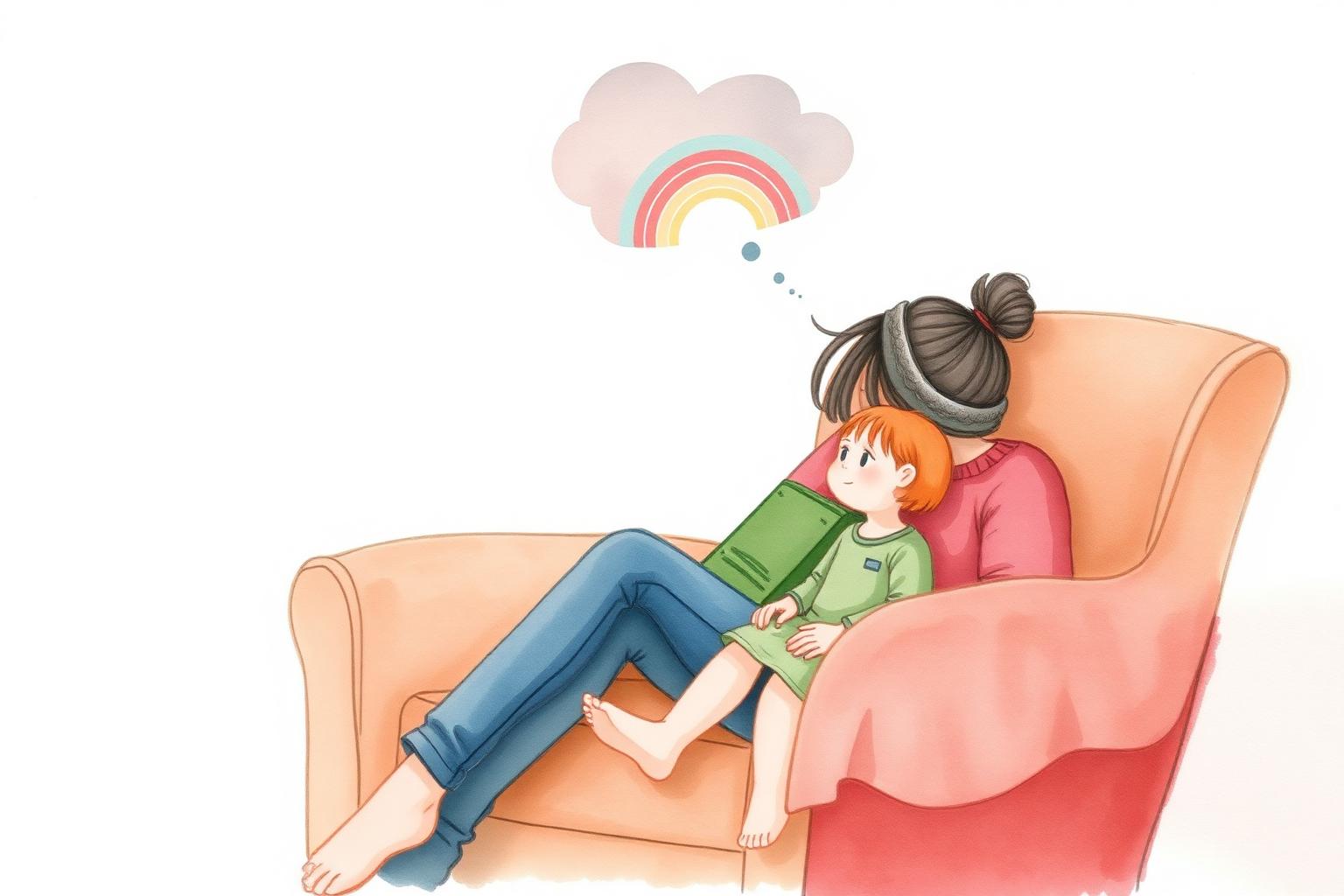
Cognitive Behavioural Therapy (CBT) is one of the most well-researched approaches for childhood anxiety. The core idea is simple: thoughts, feelings, and behaviours are connected, and changing one can shift the others. You don't need a clinical degree to bring this into your home — you just need a calm moment, curiosity, and a willingness to slow things down.
Here are six CBT-inspired techniques you can adapt for your child.
1. Name the worry (externalisation)
Give the worry a shape, a name, a voice. "It sounds like Worry Brain is talking again. What is it saying tonight?" This small linguistic shift moves anxiety from "I am scared" to "the worry is telling me to be scared." The child stops being the problem and starts being the observer.
2. Catch the thought
Anxious children often have automatic thoughts that feel like facts. Gently help them notice the thought as a thought.
- "What did your brain just say to you?"
- "Is that a thought, or is it something that already happened?"
Writing it down (or drawing it) makes it easier to look at without being inside it.
3. Check the evidence (gently)
Not debate. Not "but that's silly." Just curious investigation.
- "What makes you think that will happen?"
- "Has it happened before?"
- "What's another thing that could happen?"
The goal isn't to prove the worry wrong. It's to widen the lens so the worry isn't the only voice in the room.
4. The worry scale
Ask: "On a scale of 0 to 10, how big is the worry right now?" Then revisit later: "Where is it now?" This teaches children that feelings change — that a 9 can become a 4 — and that they can track it themselves.
5. Brave ladders (gradual exposure)
For specific fears (dogs, sleeping alone, ordering food), build a ladder together: the smallest brave step at the bottom, the goal at the top. Climb one step at a time. Praise the climbing, not the outcome.
6. Behavioural experiments
Turn the worry into an experiment. "Your brain says everyone will laugh if you put your hand up. Want to test it?" Predict, try, observe. Most experiments end with: "It wasn't as bad as I thought."
A few important caveats
- These tools work best when the child is calm, not in the middle of a meltdown.
- CBT is not about talking children out of their feelings. Validation always comes first.
- If anxiety is severe or persistent, a trained child therapist can do this work far more skillfully than any parent. These tools complement professional support — they don't replace it.
When to use which
- Before a feared event: brave ladders, behavioural experiments.
- During worry spirals: naming the worry, the worry scale.
- After it passes: catch the thought, check the evidence.
Used gently and consistently, these tools help children build something invaluable: the felt sense that their thoughts are not always true — and that they have some say in how the story unfolds.
Frequently asked questions
Is CBT safe for young children?
CBT principles can be adapted for children as young as 4 or 5 using play, drawing, and externalisation. Formal CBT therapy is typically most effective from around age 7. The home-based techniques in this article are safe at any age when used gently and without pressure.
What if my child resists these techniques?
Don't push. CBT works through curiosity, not compliance. If your child resists, drop the formal tool and just stay present. You can return to it later, or weave it into a story or game instead.
Can I do CBT instead of seeing a therapist?
These tools support your child day-to-day, but they don't replace professional care for moderate to severe anxiety. If anxiety is interfering with school, sleep, friendships, or daily life, see a qualified child therapist.
How long until I see results?
Some children respond within a few weeks; others take months. CBT works by building a new mental habit, and habits take repetition. Consistency matters more than intensity.
Is it okay to challenge my child's thoughts?
Gently, yes — but only after validating the feeling. 'That sounds really scary. I wonder if your brain might be predicting the worst — want to look at it together?' Challenge the thought, never the child.