A Children's Story About Parents Divorcing
By Soothly Editorial · 7 min read
Last reviewed June 13, 2026
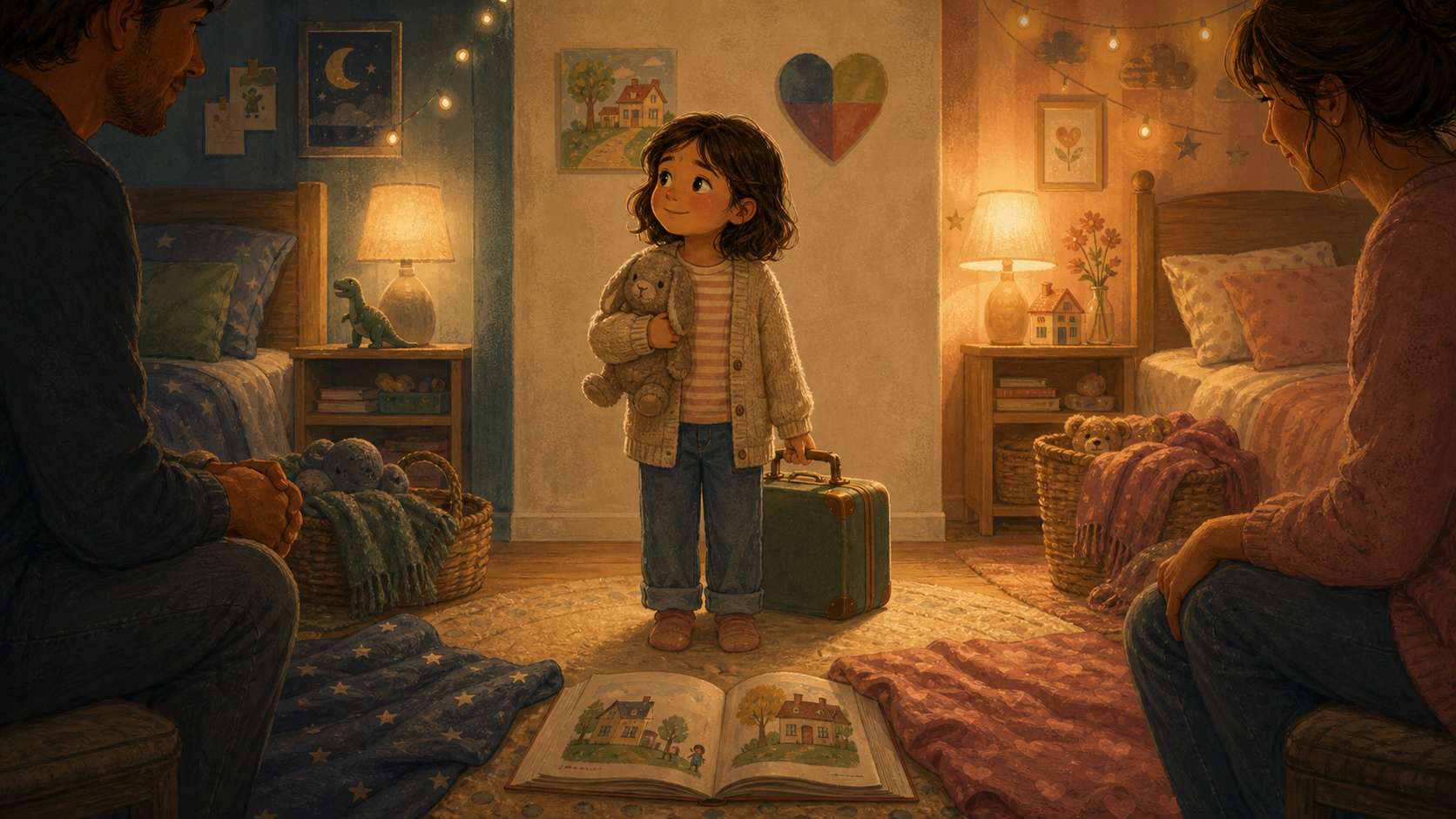
Children often understand hard changes through story before they can explain them directly.
A Children's Story About Parents Divorcing is written for a child who is living through parents divorcing and needs gentle language, not a lecture.
Use the story as-is, or swap in details from your own family.
The story
Sam noticed that the house felt different.
Not loud-different.
Not bad-different.
But different in the way a room feels when grown-ups are thinking about something big.
There was a backpack with two bedtime books on the table.
There were whispers, lists, and small pauses where ordinary words used to be.
Sam missed one dinner table, one toothbrush cup, and one goodnight hallway.
And now there was two homes with different lamps but the same child inside them.
At bedtime, Sam tried to be very brave.
Brave looked like nodding.
Brave looked like not asking the question again.
Brave looked like holding the blanket tight.
But the feeling inside did not know it was supposed to be brave.
It wobbled.
Then the Night Gardener came to the window with a lantern soft enough for hard questions.
"This is a lot," said the Night Gardener.
Sam nodded.
"I do not know where to put all of it."
The Night Gardener made a small place on the rug.
"Some changes need two baskets," the Night Gardener said. "One for what we are losing, and one for what can still stay with us."
So Sam put one memory in the first basket.
Then one comfort in the second.
Then one question in the middle, where a grown-up could help carry it.
The feeling did not disappear.
But it stopped having to hold the whole room alone.
Before sleep, Sam practiced one sentence:
"This is grown-up work. You are loved in both homes."
And for that night, the sentence was enough.
How to use this story
Read slowly and keep your voice steady. If your child asks the same question again, that does not mean you answered badly. Repetition is one way children check whether safety is still there.
You can pause after the line about two baskets and ask:
"Should we make a memory basket and a still-here basket?"
Do not force it. Some children need the image now and the conversation later.
What this story helps with
This story supports:
- naming a hard change without pretending it is easy
- separating what is changing from what is still steady
- giving questions to grown-ups
- making a small ritual for goodbye, waiting, or transition
- helping the child feel carried rather than responsible
The key need here is reassurance that the divorce is not the child's fault.
Parent script
Try:
"This is grown-up work. You are loved in both homes."
Or:
"You can ask me again. I will keep answering calmly."
Short, repeated reassurance is often more helpful than one perfect explanation.
When to get more support
Consider extra support if your child has persistent sleep disruption, panic, aggression, withdrawal, school refusal, repeated stomachaches, or if the situation involves trauma, unsafe conflict, or major ongoing uncertainty.
Create a story for your child's situation
Use your child's real worry, a familiar comfort object, and one sentence they can keep.
Create a calming bedtime story for tonight
Sources
Frequently asked questions
Can I use this at bedtime?
Yes. Keep it slow, concrete, and reassuring rather than turning it into a lesson.
Should I ask my child if the article is about them?
Usually no. Children often process indirectly through story, play, or repeated routines.
Can I personalize it?
Yes. Use your child's real comfort object, favorite character, or family language.
What if my child does not want to talk?
Do not force conversation. Offer steadiness and let the idea work quietly.
When should I get more support?
Seek support if worries or big feelings are persistent, unsafe, or affecting sleep, school, or family life.