How to help a child name their big feelings
By Tim Khuja · 6 min read
Last reviewed June 9, 2026
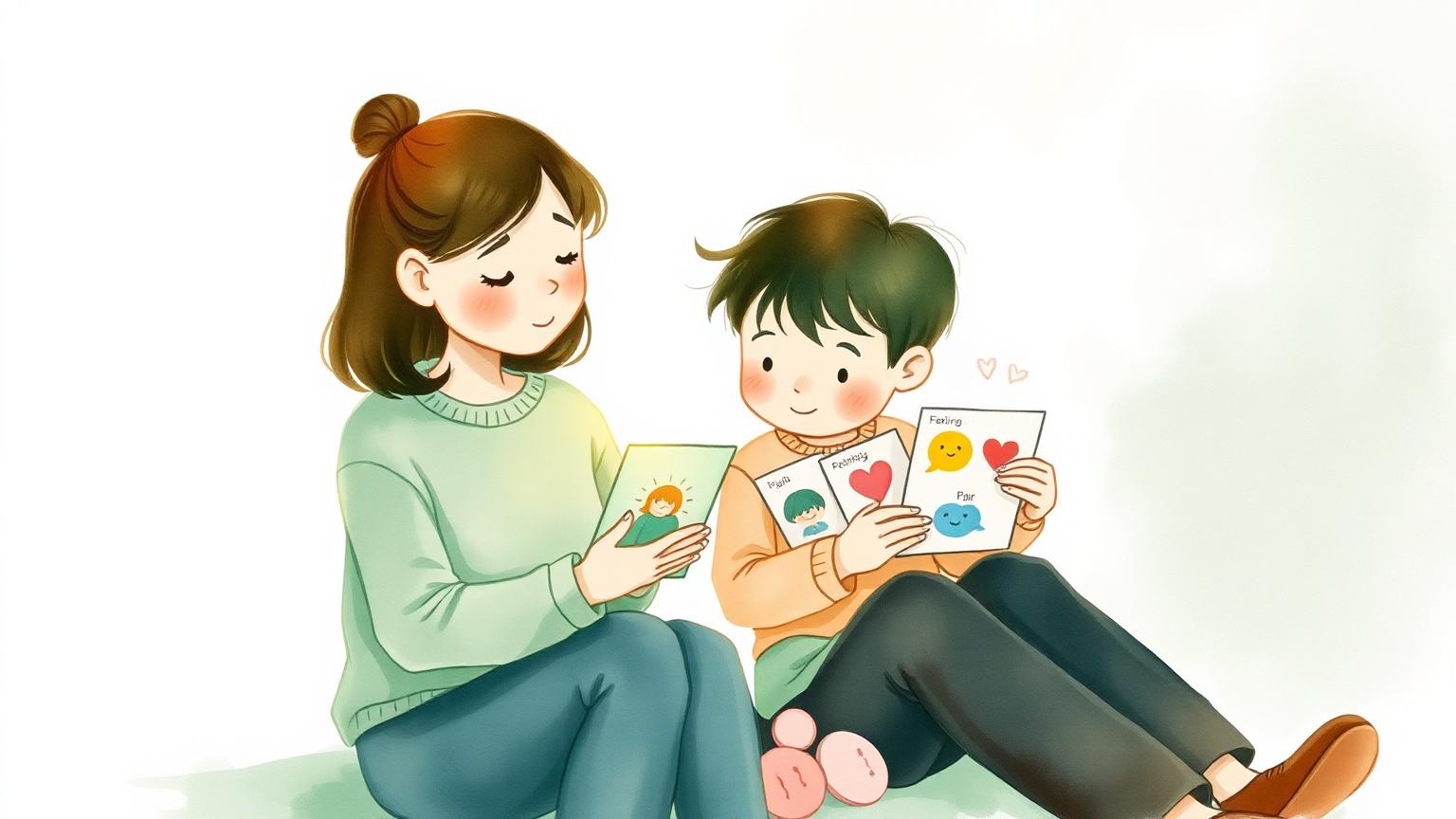
There is a moment, sometime around age four or five, when a child has a feeling so large it has nowhere to go. They hit the table. They cry about the wrong sock. They tell you they hate everything, including the soup, including you.
The instinct is to fix the soup. The work is to name the feeling.
Why naming matters
Research on affect labeling — the formal term for putting feelings into words — consistently shows the same thing: when we name an emotion out loud, activity in the amygdala drops and activity in the prefrontal cortex rises. The feeling becomes processable instead of overwhelming.
For children, who don't yet have the prefrontal architecture adults rely on, this is even more powerful. A named feeling is a feeling they can think about. An unnamed feeling is a feeling that has to be acted out.
Start with your own labels
Children learn emotional vocabulary the same way they learn every other vocabulary: by hearing it used about real things, by real people they trust.
Narrate your own feelings out loud, in small, ordinary moments:
- "I felt frustrated when the kettle wouldn't boil."
- "I'm feeling a bit nervous about tomorrow."
- "That made me sad. I'm okay, but I noticed."
Keep them small. Don't turn it into a teaching moment. The goal is to make naming feelings something normal adults do, not something special children should do.
Offer, don't interrogate
When your child is in the middle of a feeling, do not ask "how are you feeling?" They don't know. Their nervous system is online; their vocabulary is offline.
Offer a guess instead, gently, and let them correct you:
- "I think you might be frustrated."
- "It looks like something feels unfair."
- "That seemed disappointing."
If you're wrong, they'll often tell you the right word. That correction is the learning.
Use stories as a vocabulary trojan horse
This is where therapeutic storytelling earns its keep. A character in a story can feel jealous of a new sibling, terrified of the dark, ashamed about an accident at school — and the child can meet those words in safety, attached to a body that isn't theirs.
This is the entire logic behind Soothly's stories for big feelings: the story externalises the emotion, gives it a name and a shape, and shows the character (and the listener) that the feeling is survivable.
After the story, you don't need to debrief. The vocabulary is now in the room.
A small feelings vocabulary to start with
Most children rely on a tiny emotional palette: happy, sad, angry, tired. Stretching that palette is the work of years, but here's a starter set to use yourself, in front of them, for a week:
- Frustrated — when a thing won't work the way I want.
- Disappointed — when something I was looking forward to didn't happen.
- Overwhelmed — when there's too much to feel or do at once.
- Worried — when my body is thinking about something hard.
- Lonely — when I want company but don't have it.
- Proud — when I did something hard and I notice it.
Use one of these a day, about yourself, in their hearing. Within a month, you'll hear them try one on.
What not to do
- Don't correct their emotion. "You're not sad, you're tired" teaches them not to trust their own signals.
- Don't rank feelings. "That's nothing to cry about" teaches them to hide the next one.
- Don't make naming the feeling the price of comfort. "Tell me what you're feeling and then I'll hug you" turns vocabulary into a hostage situation.
The rule is simple: hug first, name second, talk third. Often, you never get past the hug. That is also fine.
The long arc
A child who grows up hearing emotions named — calmly, accurately, without judgement — becomes a child who can name them in themselves. That single skill is the foundation under almost every adult emotional capacity we hope they develop: self-awareness, empathy, the ability to ask for help.
It's not built in a session. It's built in a thousand small moments where you said the word for what was happening in the room, and they noticed.
Frequently asked questions
At what age can a child start naming their own feelings?
Most children can label basic feelings (happy, sad, angry, scared) around age 3. More nuanced labels like disappointed, frustrated, or overwhelmed typically arrive between 5 and 7, with consistent modeling from adults.
What if my child refuses to talk about feelings?
That's normal and not a problem. Forced naming backfires. Keep modeling your own out loud and offering gentle guesses without requiring an answer. The vocabulary builds passively.
Is it okay to name a feeling for my child if I'm not sure?
Yes — frame it as a guess. 'I think you might be feeling…' lets them correct you, and the correction itself is the learning.
How are stories better than just talking about emotions?
A story externalises the feeling — it's the character's problem, not the child's. That distance lets the child process the emotion without defending against it, and gives them shared vocabulary to use later.