How to help a child name jealousy when a sibling arrives
By Tim Khuja · 7 min read
Last reviewed June 9, 2026
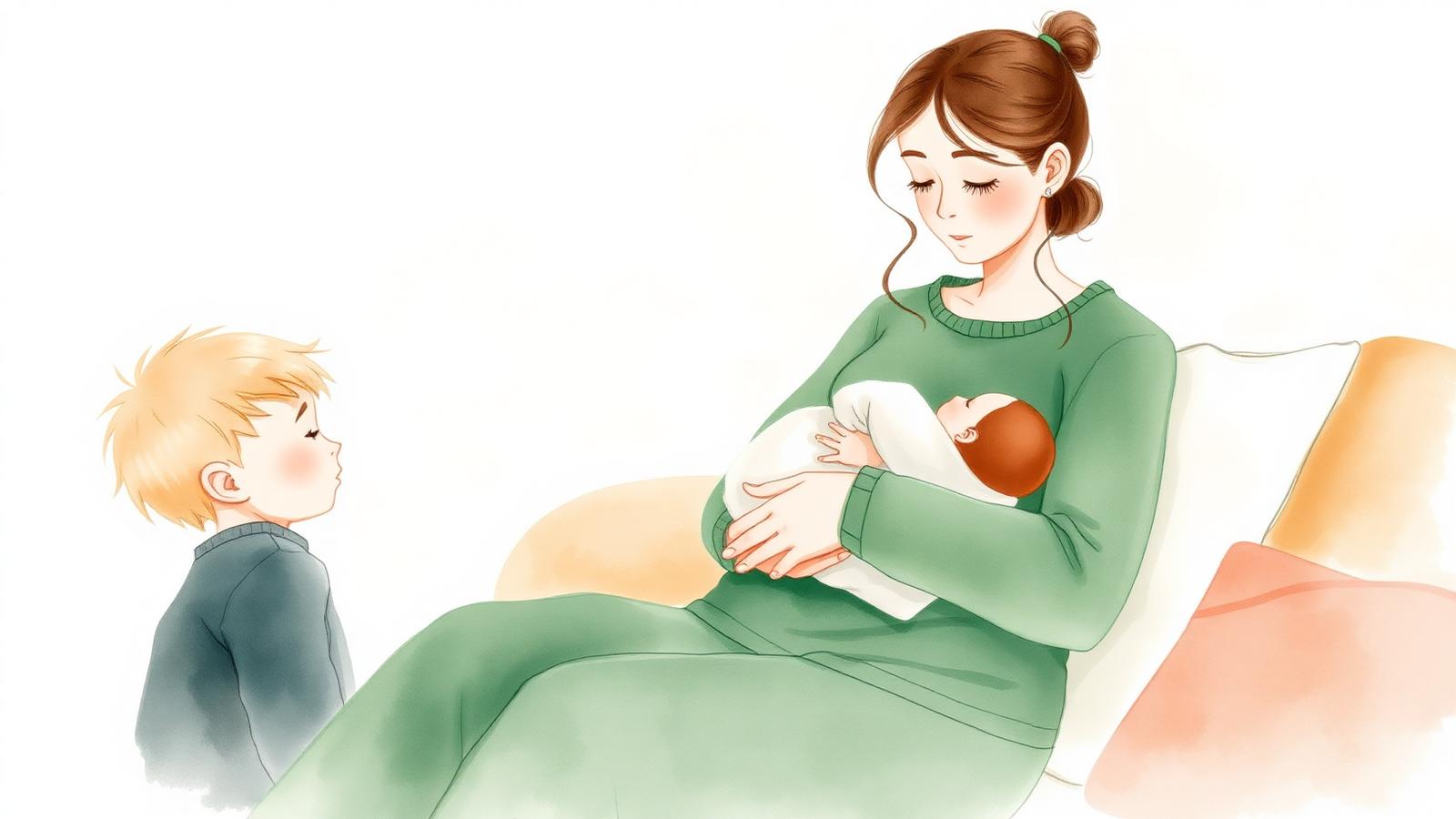
There is a particular kind of small face that every parent of a second child eventually sees. The older sibling, standing in the doorway, watching you hold the baby. Not crying. Not angry. Just… still. Watching.
In that moment, almost every parent feels the same thing: a small, sharp guilt. Because you can see, on the face of someone you have loved for three or four or five years, that something in their world has just rearranged itself — and they did not get a vote.
This piece is about that face. About what is happening behind it, what your child is actually trying to tell you, and how to help them put words to a feeling that, even for adults, is one of the hardest to name out loud: jealousy.
Jealousy is not a character flaw
The first and most important thing to know is that jealousy of a new sibling is not a sign that your child is selfish, badly raised, or "not coping." It is a sign that they understand exactly what has happened.
Until very recently, your older child lived in a world in which they were the unambiguous centre of their parents'' attention. Now they are sharing you with someone who is, by all the metrics that matter to a small human, winning. The baby gets held more. The baby cries and adults come running. The baby is the reason you are tired, distracted, slower to come when called.
A three- or four- or six-year-old does not have the cognitive equipment to think, of course the baby needs more — babies always do, it''s temporary, I''m still loved. That is an adult thought built on an adult understanding of time and need. What they have instead is a feeling — a tight, hot, uncomfortable feeling in the chest — and almost no language for it.
So it comes out sideways. Suddenly they can''t do up their own buttons. They want to be fed on your lap. They are mean to the dog. They have meltdowns about socks. They ask, repeatedly and pointedly, when the baby is going back.
None of this is misbehaviour. All of it is jealousy without a name.
Why naming it actually helps
There is a beautiful piece of research — much of it associated with neuropsychiatrist Dan Siegel''s work — sometimes summarised as "name it to tame it." When a child (or an adult) puts a precise word to a strong feeling, the parts of the brain involved in language and reflection come online, and the parts of the brain involved in pure emotional reactivity quiet down.
The opposite is also true. A feeling that has no name stays in the body. It comes out as a tantrum, a stomach ache, a sock meltdown, a sudden inability to share a toy that they were happy to share last week.
Helping your child name jealousy is not the same as agreeing that the baby is the problem. It is much more like opening a small window in a stuffy room. The feeling stops being a vague pressure and becomes a thing they can look at — and once they can look at it, they have a choice about what to do with it.
What jealousy is actually made of
Before you can help your child name it, it''s worth noticing that jealousy is almost never just one feeling. Underneath it, you''ll usually find some combination of:
- Loss. Of being the only one. Of a specific kind of attention.
- Fear. That there isn''t enough love to go around. That they have been replaced.
- Confusion. They were told the baby would be wonderful, and a lot of the time, the baby is just loud.
- Guilt. Especially in older children — they sometimes know they''re supposed to feel love, and they feel love mixed with something else, and they don''t know what to do with the mixture.
- Love, actually. Almost every jealous older sibling also loves the baby. That is part of what makes it so confusing.
When you talk about it, try to leave room for all of those, not just the one that''s on the surface that day.
Three sentences that do a lot of work
If you remember nothing else from this piece, here are three sentences that, used at the right moments, change the temperature of the whole first year.
1. "It makes sense that this feels hard." This is the antidote to the feeling that something is wrong with them for not being delighted. It doesn''t agree with the behaviour. It agrees with the feeling underneath.
2. "You can love the baby and also wish things were how they used to be. Both can be true." This is, for many older siblings, the first time anyone has told them that two feelings can live in the same body at the same time. It is genuinely a revelation.
3. "I miss you, too. I''m going to find a way for us to have time that''s just ours." Then, crucially, you do. Even ten minutes a day, predictably, with the baby genuinely not in the room, is more healing than any number of conversations about how the baby loves them.
Things that quietly make it worse
Some well-meaning parenting moves, especially in the first few weeks, accidentally make jealousy harder to name.
- "You''re the big one now." Children often hear this as you no longer get to be looked after. If anything, an older sibling needs more babying for a while, not less.
- Talking only about the baby. Visitors do this without realising. If you can, gently steer the first conversation when someone arrives toward the older child. ("Did you know she taught the baby a song yesterday?")
- Forced affection. Give the baby a kiss! If your child doesn''t want to, that''s information. Pushing it teaches them that their genuine feelings are inconvenient and should be hidden.
- "You don''t really mean that." When they say something hard — I wish the baby would go back — try not to argue with the sentence. Try to be curious about it. Tell me what would be different if the baby went back. What do you miss?
The goal is not to talk them out of jealousy. It is to make jealousy a feeling they can say out loud at home, instead of one they have to act out at school.
Using stories to put it into words
Children often can''t talk about their own jealousy directly. It''s too close. But they can talk about a character''s jealousy at enormous length and with remarkable insight.
This is one of the most useful things stories do for children at any age, and it is especially powerful for sibling jealousy. A story about a small fox whose family suddenly has a new fox cub — and who feels something tight and hot in their chest, and doesn''t know what it''s called — gives your child a safe distance from which to look at their own feeling. By the time the small fox in the story finds out the feeling has a name, and that the parent foxes still love them just as much, your child has, quietly, learned the same thing.
This is part of why Soothly stories about new siblings work so well. When the character is your child, by name, with your family, the recognition is immediate — and the parent guidance afterwards gives you the exact sentences for the conversation that almost always follows.
A note on timing
Most acute sibling jealousy peaks somewhere in the first three to six months after a baby arrives, softens through the second half of year one, and changes shape — but rarely fully disappears — through the toddler years. There will be a second small wave when the baby starts taking the older child''s toys and a third when the baby starts winning the parent''s laugh. Each wave is a chance to use the same skills again.
If, six months in, your older child seems persistently sad rather than intermittently jealous — withdrawn, losing interest in things they used to love, regressing in ways that don''t soften — that is worth a gentle conversation with your GP. Not because anything is wrong, but because a few sessions of play-based support can do an enormous amount of good at this age.
The thing your child actually needs to know
In the end, almost every conversation about sibling jealousy is your child asking the same question in slightly different words:
Do you still love me the same?
The answer is not really in your sentences. It''s in the ten minutes alone in the kitchen, making pancakes badly. It''s in the way you look at them when they walk in the room. It''s in the bedtime story that is just theirs.
You don''t need to convince them with words that there is enough love. You need to show them, in small ways, every day, that there is. Their jealousy will soften as the evidence accumulates.
And one day — usually around the time the baby starts laughing at their jokes — you will turn around and find them, unprompted, kissing the top of the baby''s head. Not because you told them to. Because somewhere in the long, complicated, jealous, loving first year, they decided, on their own, that this small loud person was theirs.
That is the moment all of this was for.
Frequently asked questions
How early before the baby arrives should I start preparing my older child?
For most children, somewhere in the last two months of pregnancy is the sweet spot — early enough that it isn't a shock, late enough that it doesn't feel like an abstract forever-away thing. Younger children (under four) often do better with even less notice — a few weeks — because their sense of time makes a long countdown feel confusing. Whatever the timing, the most useful preparation is honest: babies are lovely and also loud, you'll still be their parent, and some of it will feel hard.
My older child is being aggressive with the baby. Is that normal?
Mild aggression — a sudden squeeze, a too-rough kiss, a toy taken back hard — is extremely common and almost always a way of saying 'I have a big feeling and no words for it.' Stay calm, keep the baby physically safe, and name what you saw: 'You squeezed hard. I think you're feeling something big. Let's find out what.' Persistent, planned, or escalating aggression that doesn't soften with co-regulation over several weeks is worth a conversation with your GP.
What if my older child says 'I hate the baby'?
Try not to flinch, argue, or rush to correct them. 'I hate the baby' is almost always shorthand for 'I hate how much has changed, and I don't know how to say that.' Try: 'That's a really strong feeling. Tell me what's the hardest part right now.' You'll almost always discover that the actual complaint is much more specific — and much more solvable — than the headline.
Will having dedicated one-on-one time with the older child really help that much?
Yes, more than almost anything else. Even ten to fifteen genuinely undivided minutes a day, at a predictable time, with the baby out of the room, refills the older child's sense of being seen in a way that no amount of general reassurance can. The predictability matters as much as the duration. 'After the baby's morning nap, that's our puzzle time' is more powerful than a longer but unpredictable block.