Night-time Fears: Monsters, Shadows, and the Imagination
By Tim Khuja · 8 min read
Last reviewed June 9, 2026
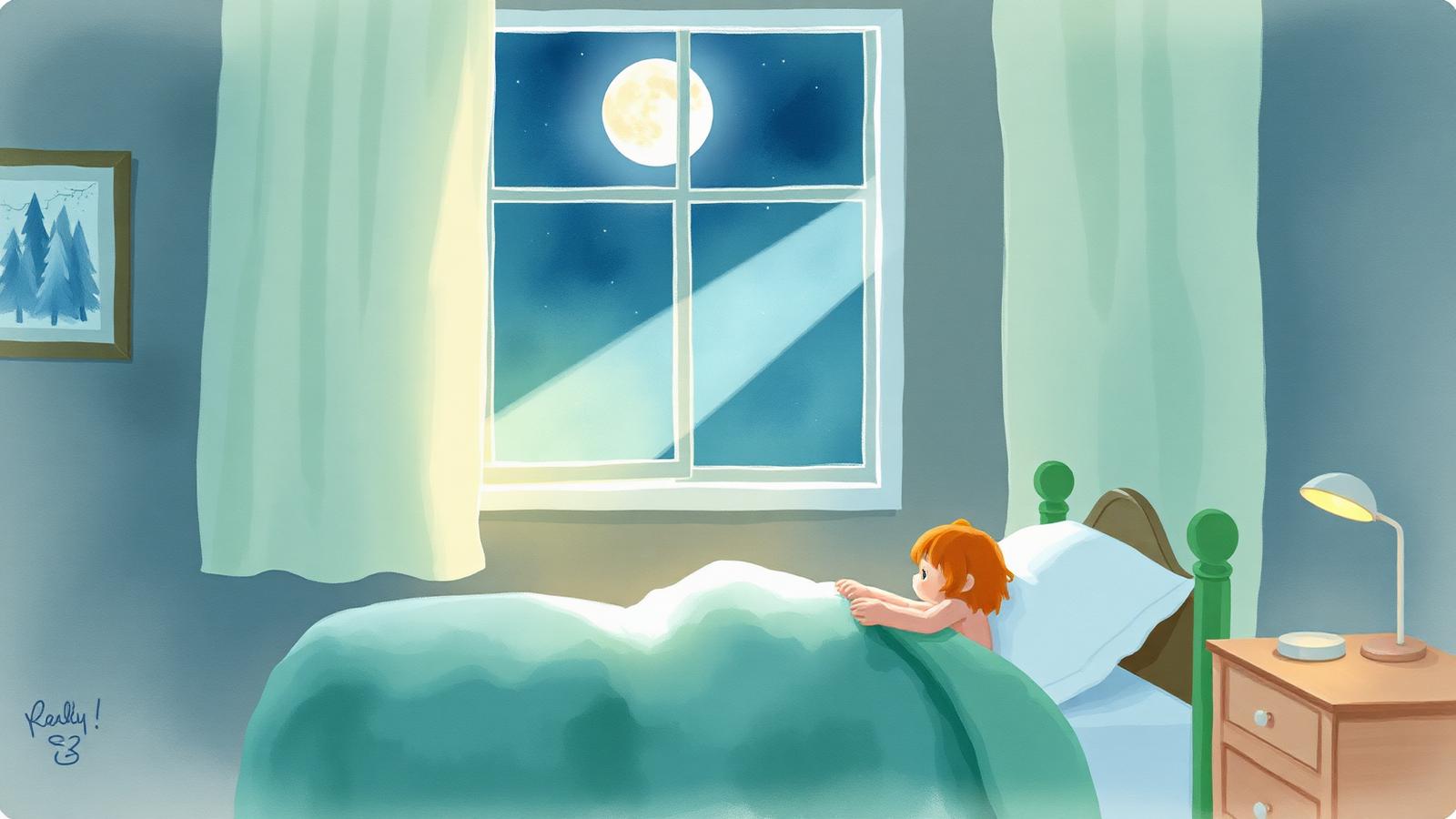
It almost always starts the same way. A small voice from the dark hallway. A second small voice, closer this time, at the side of the bed. "There''s something in my room."
You go in. You turn on the light. You show them, again, that the shape in the corner is the laundry basket, that the shadow on the wall is the curtain, that the noise in the wall is the heating coming on. They nod. They agree. And then, twenty minutes later, the voice is back.
If this is your life right now, the first thing worth saying is: this is not a behaviour problem. Night-time fears in children between roughly three and eight are developmentally normal, very common, and almost always a sign that something beautiful is happening in your child''s brain — not something broken.
Why the imagination gets louder at 4am
Between the ages of three and six, children make an enormous cognitive leap. They develop what psychologists sometimes call symbolic thinking: the ability to picture things that aren''t physically in the room. This is the same skill that lets them play pretend, draw, build worlds out of cushions, and tell you stories.
It is also the skill that, at 4am, lets them picture a monster behind the door.
The imagination doesn''t come with an off-switch. A four-year-old cannot decide to stop imagining the wolf in the same way you cannot decide to stop hearing a song stuck in your head. The image arrives, fully formed, and the body responds as if it were real. Heart rate goes up. Breathing gets shallow. The hallway feels longer than it did in the daytime.
At night, this is amplified by three things working at the same time:
- The room is darker. With fewer visual cues, the brain fills in the gaps. A coat on a chair becomes a shape. A shape becomes a figure.
- The house is quieter. Small sounds — pipes, the fridge, a car outside — suddenly take up more of the auditory space.
- Your child is alone. During the day, you are nearby. At 2am, in a room with the door half-closed, they are facing all of this without their co-regulator.
This is why the same child who walks confidently into a forest on a hike will cry at the shadow of a coat hook. It''s not inconsistency. It''s context.
Why "there''s nothing there" doesn''t work
Almost every parent tries the rational route first. Look, see, there''s nothing there. It''s just your jacket. And it almost never works for long.
The reason is that you are answering a question your child didn''t quite ask. They are not really saying "I believe there is a monster" in the way an adult would say it. They are saying something more like: "My body feels scared and I don''t know what to do with that feeling, and the only language I have for it is monster-shaped."
When you reply with "there''s no monster," you''ve answered the literal sentence but missed the emotional one. The fear in their body hasn''t gone anywhere. So a few minutes later, the fear finds a new sentence — a shadow, a sound, a different room.
This isn''t your child manipulating you. It''s your child looking, in the dark, for the only thing that has ever reliably made the scared feeling go away: you.
What to do in the moment
When your child calls out at night, try this sequence. It''s slower than reasoning, but in our experience it actually ends the night faster.
1. Go in calmly, even if it''s the fourth time. Your nervous system is the room''s nervous system right now. If you arrive frustrated, the fear gets louder. If you arrive calm — even a performed calm — the room settles. You don''t have to feel patient. You have to look patient for ninety seconds.
2. Name the feeling, not the thing. Instead of "there''s no monster," try: "Your body feels really scared right now. That''s a horrible feeling in the middle of the night. I''m here." You are not agreeing that there is a monster. You are agreeing that the feeling is real. Because it is.
3. Lend them your body for a minute. Sit on the edge of the bed. Put a hand on their back or chest. Breathe slowly and audibly. Children co-regulate through proximity and breath long before they can do it on their own. Ninety seconds of this often does more than ten minutes of explanation.
4. Offer one small, repeatable ritual. Not a new ritual every night. The same one, every time. A "goodnight" to the room. A specific sentence ("the house is safe, the door is open a little, I''m just down the hall"). A torch they can switch on themselves if they need to check. Predictability is the antidote to night-time fear, because the unknown is most of what they''re afraid of.
5. Leave before they''re fully asleep, if you can. This is the hardest part. If you stay until they''re unconscious every night, the room teaches them: I need a parent in the room to feel safe. If you can leave while they''re drowsy but still aware, the room slowly teaches the opposite: I can find sleep in here, on my own, with my person close by.
What to do during the daytime
Most of the work on night-time fear actually happens between 9am and 5pm. By the time you''re standing in a dark hallway in pyjamas, the room''s job is just to not make things worse.
In the daytime, three things help.
Talk about the fear when no one is afraid. Over breakfast, in the car, on a walk. "Last night you said there was something in your room. I''ve been thinking about that. What does it look like? Does it have a name?" Putting words and even a name to the fear shrinks it. A nameless dread is enormous. A monster called Steve is, somehow, much smaller.
Let them be the brave one in a story. This is where stories do something that no amount of reassurance can. A story where a character their age feels exactly the same kind of fear — and finds, through the arc of the story, that the fear gets smaller when it is named, looked at, or befriended — gives your child a script for their own night. They don''t have to invent courage from scratch. They get to borrow someone else''s.
This is one of the reasons we built Soothly: a personalized story where your child meets the shadow in their room and finds out it''s actually something else, can change a child''s relationship with bedtime in a way no rational conversation ever quite does.
Look after the daytime nervous system. A child who has been overstimulated all day — long screen time, big social demands, a busy weekend — will have a much louder imagination at night. This isn''t a moral failing of modern life; it''s biology. A slower late afternoon, a long bath, a real dinner with you, and a bedtime that is the same time every night will reduce night-time fears more than any reassurance will.
When to worry, and when not to
Almost all night-time fears in young children pass. They peak somewhere between four and six, soften through seven and eight, and are mostly gone by nine or ten. If your child is in this window and the fears come and go in phases — worse for a few weeks, better for a few months, worse again after a big change — that is the normal shape of it.
A few things are worth paying attention to:
- Fear that is paired with a specific event (a film, a story, a real frightening experience) and won''t soften over a few weeks.
- Fear that is stopping your child from doing daytime things they used to enjoy.
- Fear that comes with physical symptoms during the day — tummy aches before bed every night, refusal to be in any room alone, panic that doesn''t soften with co-regulation.
If any of those is true for more than a month or two, it is worth a conversation with your GP or a child psychologist. Not because something is wrong, but because a few sessions of gentle, age-appropriate work can shorten what would otherwise be a long, slow stretch.
A note for the parent in the hallway
The thing nobody tells you about night-time fears is how hard they are on the adult. You are tired. You have done this five nights in a row. You may have an early meeting. The fourth visit, at 3:47am, will not feel patient.
This is normal. You are not failing because you sighed. You are not undoing your child''s sense of safety by being human. The thing that builds trust over time isn''t the perfect response on any one night — it''s the fact that, again and again, you came in.
Your child won''t remember the exact sentences you said. They will remember, in their body, that when they were scared in the dark, someone they loved kept showing up.
That is, in the end, the only monster that mattered. And you''ve already beaten it.
Frequently asked questions
At what age do night-time fears usually peak, and when do they fade?
Night-time fears most commonly peak between ages four and six, soften through ages seven and eight, and are usually largely gone by nine or ten. They tend to come in waves — worse for a few weeks, then better — especially around developmental leaps or after big changes like starting school or a house move.
Should I check under the bed and in the closet, or does that reinforce the fear?
A single, calm, matter-of-fact check is usually fine and can help — it shows your child you take the feeling seriously. What tends to reinforce the fear is a long, anxious, repeated search. The message you want to send is: 'I can see this and there's nothing to worry about,' not 'I am also genuinely scanning for danger.' One look, one sentence, then back to the comfort and the ritual.
My child only gets scared at our house, not at the grandparents'. Why?
Almost always because the bedroom routine is different in the other place — usually slower, with more adult presence at sleep time, less time alone in the room before sleep, or a more cluttered sensory environment that makes the dark less stark. It is rarely about your house being scary. It is usually about the specific conditions of solo bedtime, which are a particular skill your child is still learning.
Is it okay to let them sleep in our bed when they're scared?
There is no single right answer, and short-term it's often the kindest thing. The thing to watch is whether it becomes the default, because then the child's nervous system never gets the chance to learn that their own room is safe. A middle path that works for many families: come into their room, settle them there, stay until calm, leave before fully asleep. Reserve your bed for genuinely hard nights, not every night.