Perfectionism in Children: When Good Enough Is Hard
By Tim Khuja · 8 min read
Last reviewed June 9, 2026
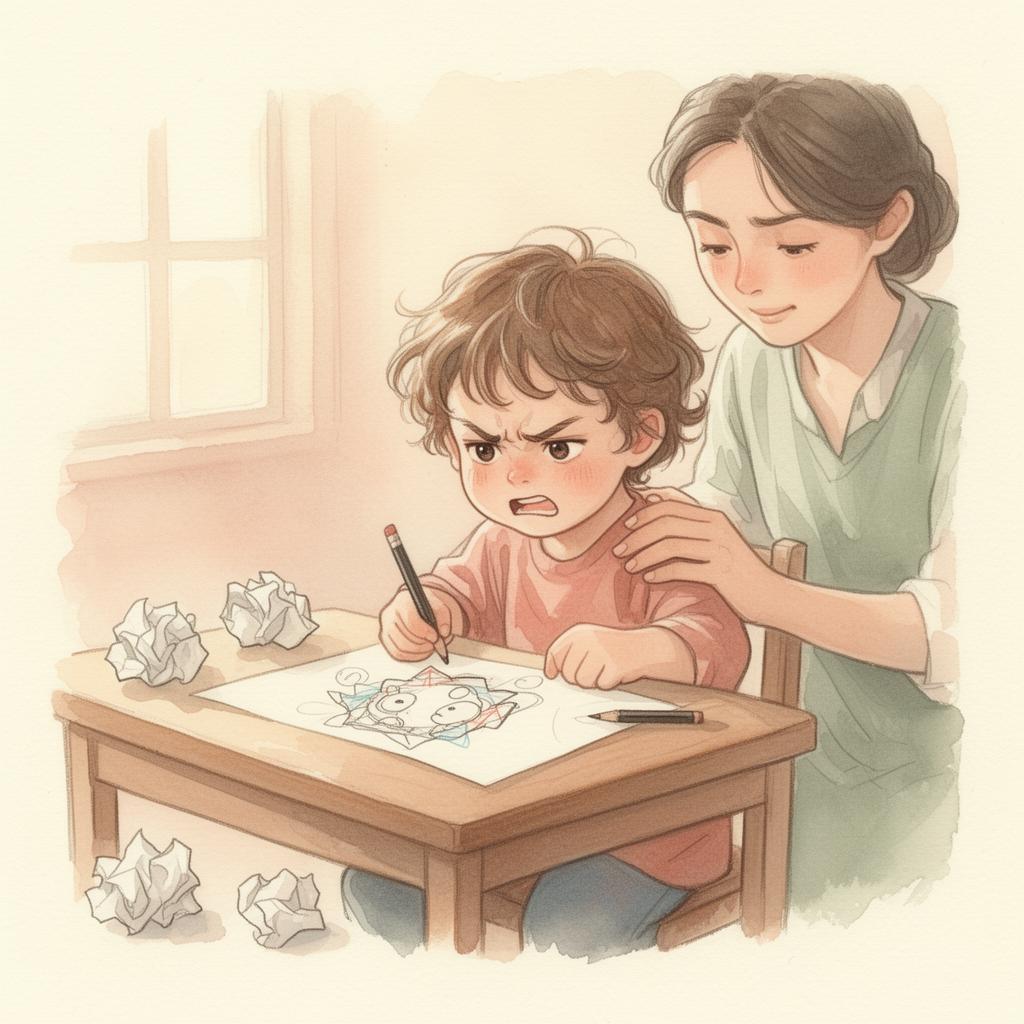
Every parent has seen it: the drawing torn up because one eye was slightly bigger than the other. The homework redone three times. The refusal to try a new sport because "I'll probably be bad at it." Perfectionism in children doesn't always look like achievement. Often, it looks like avoidance, self-criticism, and distress that seems out of proportion to the situation.
Perfectionism is not a character flaw, and it's not a sign that your child is destined for greatness. It is an anxiety pattern — a belief that one's worth depends on getting things exactly right. And like all anxiety patterns, it can be softened with the right understanding and support.
What childhood perfectionism looks like
Perfectionism manifests differently at different ages. In younger children, you might see:
- Ripping up artwork or refusing to show it
- Extreme frustration when a game doesn't go their way
- Avoidance of new activities where they might "fail"
- Needing excessive reassurance that something is "right"
- Distress over small mistakes, like a letter written slightly outside the line
In older children, perfectionism often becomes more internalized:
- Procrastination on assignments due to fear of not doing them well enough
- Overworking on tasks far beyond what is required
- Social comparison and harsh self-judgment
- Difficulty accepting praise ("It wasn't that good")
- Physical symptoms: headaches, stomach aches, trouble sleeping before a test or performance
The common thread is not high standards. It's the emotional cost of those standards. A child with high standards can feel disappointed and move on. A perfectionistic child feels their very self is at stake.
Where perfectionism comes from
Perfectionism rarely has a single cause. It usually emerges from a combination of factors:
Temperament. Some children are born with a more cautious, detail-oriented nervous system. They notice small discrepancies, feel discomfort with uncertainty, and set high internal standards naturally. This isn't a problem until it becomes rigid.
Environment. Subtle messages matter enormously. A parent who rewrites a child's homework "to make it neater." A teacher who only displays the "best" art. A culture of achievement that rewards outcomes more than effort. Children are exquisitely sensitive to what makes the adults around them pleased.
Modeling. Children watch how adults handle mistakes. If a parent is visibly distressed by a typo in an email, a failed recipe, or a minor criticism at work, the child absorbs a template: Mistakes are dangerous. Getting things right is how you stay safe.
Attachment and belonging. At its core, perfectionism is often a strategy to guarantee love. The child has learned — sometimes accurately, sometimes inaccurately — that their value is conditional on performance. This is never a conscious choice. It is a child's best attempt to secure connection in a world that feels uncertain.
How perfectionism hurts
Perfectionism doesn't just make children anxious. It narrows their world. A perfectionistic child may avoid challenges, give up quickly, or refuse to try at all. They may struggle with friendships because social situations are inherently unpredictable. They may develop a fixed mindset, believing that ability is static and that effort is evidence of inadequacy.
Over time, untreated perfectionism is a significant risk factor for anxiety disorders, depression, and burnout. It teaches a child that their inner experience is unacceptable — that they must perform their way into being lovable.
Strategies that help
Separate worth from outcomes
The most important message a perfectionistic child needs is that they are loved and worthy regardless of what they produce. This isn't a message you deliver once. It's a message you live:
- Celebrate effort, not just results. "I noticed you kept trying even when it got hard."
- Show interest in process, not product. "What was the most interesting part of making this?"
- Share your own mistakes openly. "I burned the pancakes this morning. Oh well — we'll have toast instead. Mistakes happen."
Normalize mistakes as part of learning
Help your child see that every skill is built through error. Talk about how athletes, artists, and scientists all practice, fail, and improve. Read biographies of people who struggled before succeeding. The goal is to shift the narrative from I must be good at this to I'm learning, and learning includes not knowing yet.
Introduce the concept of "good enough"
Perfectionistic children often don't know that "good enough" is an option. You can gently introduce it: "Does this do what it needs to do? Is it finished? Then it's good enough. We don't need to make it perfect." This may feel uncomfortable at first — to you as well as to your child — but it's a crucial reframe.
Teach self-compassion
When your child is being harsh with themselves, help them notice it: "You're being really hard on yourself right now. If your best friend made this mistake, what would you say to them?" Children are often far kinder to imagined friends than to themselves. This exercise builds the skill of self-compassion, which is one of the most robust buffers against perfectionism.
Set boundaries on reassurance-seeking
Some perfectionistic children ask repeatedly: "Is this okay? Did I do it right?" While it's tempting to keep reassuring, this can reinforce the anxiety cycle. Instead, try: "I've already told you I think it's great. What do you think?" or "You've checked three times. Let's agree that this is finished." This teaches your child to tolerate uncertainty rather than seeking endless external confirmation.
Watch your own perfectionism
This is perhaps the hardest part. If you are perfectionistic — and many parents of perfectionistic children are — your child is watching. Notice your own all-or-nothing thinking. Notice when you overwork, overprepare, or criticize yourself harshly. Modeling self-compassion and "good enough" in your own life is more powerful than any words you can say.
When to seek extra help
If your child's perfectionism is causing significant distress, interfering with school or friendships, or contributing to physical symptoms like sleep problems or chronic stomach aches, consider speaking with a child psychologist. Cognitive-behavioral therapy (CBT) has strong evidence for treating childhood perfectionism and anxiety. Early support can prevent a lifelong pattern.
A final thought
Perfectionism is a child's attempt to feel safe in an uncertain world. It deserves compassion, not correction. Your job is not to convince your child that mistakes don't matter. Your job is to help them feel that they matter — mistakes, struggles, and all. That feeling, once truly internalized, is the foundation of a life lived with courage rather than fear.
Frequently asked questions
Is perfectionism the same as having high standards?
No. High standards are motivating and flexible — a child can feel proud of effort and adjust goals. Perfectionism is rigid and self-critical. A perfectionistic child believes their worth depends on getting things exactly right, and mistakes feel like personal failures rather than learning opportunities.
Where does childhood perfectionism come from?
It usually arises from a mix of temperament (some children are naturally more cautious and detail-oriented), environment (subtle pressure to perform, even if well-intentioned), and internalized beliefs about what makes them lovable. It's rarely one thing — and it's never a child's fault.
Should I tell my perfectionistic child that nobody's perfect?
That phrase rarely lands well because, to the child, it feels dismissive of their very real distress. Instead, validate the feeling first: 'It's really hard when something doesn't look the way you wanted. You care a lot about getting it right.' Then, when they're calmer, share small stories of your own mistakes and what you learned.
When should I seek professional help for perfectionism?
If your child's perfectionism is causing them significant distress, avoiding activities they used to enjoy, triggering frequent meltdowns, or contributing to physical symptoms like stomach aches or sleep problems, it's worth speaking with a child psychologist. Early support can prevent perfectionism from becoming a lifelong anxiety pattern.